The Myth of Migration Paralysis: How to Switch App Providers With Zero User Loss
Part of the Is Your App Builder Holding Your Brand Hostage? 5 Counter-Intuitive Truths series.
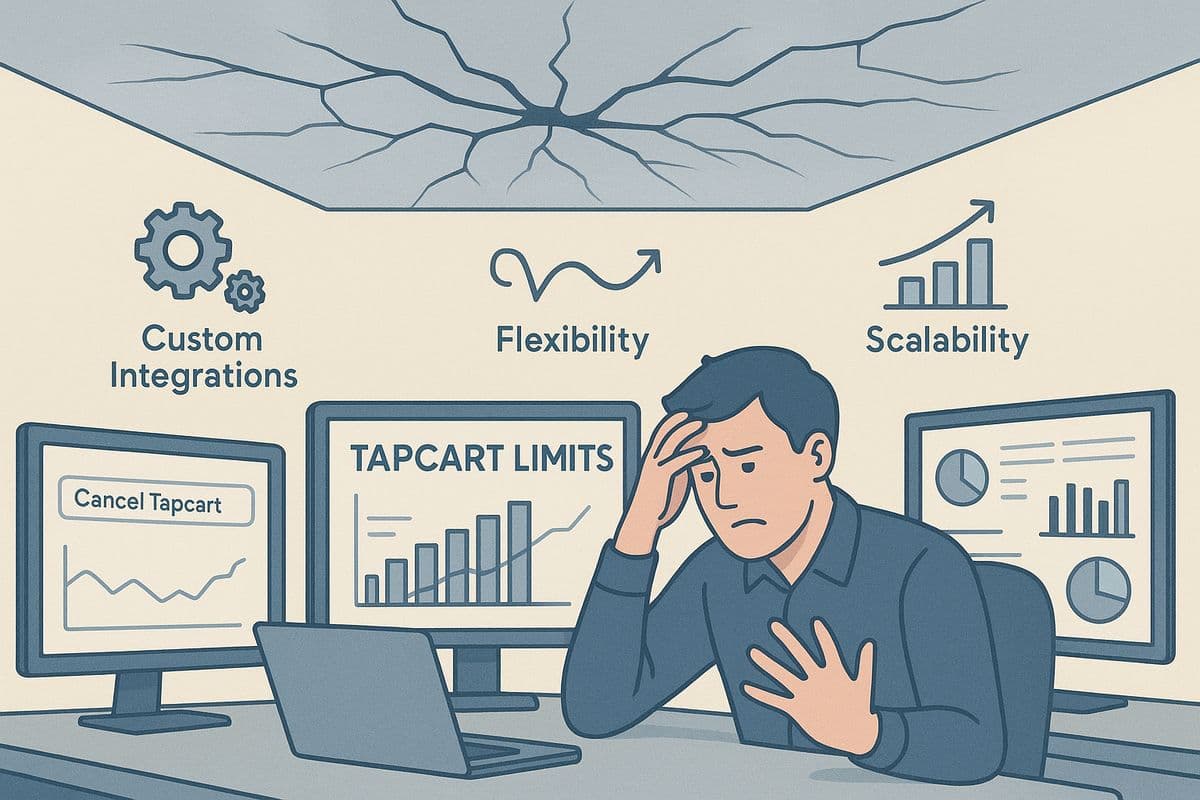
As an e-commerce brand scales, it’s common to hit a “Hidden Ceiling” with standardized SaaS app builders like Tapcart or Vajro. The platform that once provided speed and simplicity now feels restrictive, where the standardized, multi-tenant architecture that once enabled speed now prevents the deep, custom integrations your unique business processes require. This feeling of being trapped often leads to high-anxiety searches like "Cancel Tapcart."
The core fear behind this hesitation is the belief that switching providers means a disruptive re-launch. Merchants worry they will be forced to abandon their entire user base, lose their hard-won push notification subscribers, and start from scratch.
This is a myth. A seamless, zero-loss migration is not only possible—it’s a necessary strategic upgrade for any brand ready to break through its growth ceiling. Here are the four surprising truths that make it possible.

Your Biggest Fear Isn't Losing Features—It's Losing Your Data
Many merchants feel paralyzed when they consider leaving their app provider. The deepest source of this anxiety isn't about features; it's about data sovereignty. This anxiety often stems from a startling discovery buried in the provider's terms of service: terminating your SaaS contract could lead to the deletion of your customer data, with the vendor having no liability for the loss, as per their own terms.
The realization—that a core business asset (the customer profile database) is immediately vulnerable upon contract termination—is often the root cause of migration paralysis.
Switching providers, therefore, is not just a technical choice. It is a strategic move to regain full control and ownership over one of your most valuable assets.

You Can Migrate Every User Without a Single Password Reset
A common migration nightmare is forcing your entire user base to reset their passwords, a move that guarantees massive churn. Modern security standards make it impossible to directly transfer encrypted passwords from one system to another. The solution, however, is an elegant strategy called "Just-In-Time" (JIT) migration.
Here is how it works in simple terms:
• When an existing user opens the new app for the first time and logs in, the system momentarily authenticates their old credentials against the old provider's API.
• If the login is successful, the new system instantly and securely creates their account in the new database.
• This entire process is invisible to the user. There are no password reset prompts and no friction—just a seamless login experience.
Legal frameworks like GDPR’s "right to data portability" legally mandate that legacy providers cooperate with the export of non-sensitive data needed to make this process work. This solves one of the biggest sources of customer friction and directly preserves 100% of your existing user base.

Your Most Valuable Marketing Channel Can Move With You
For many brands, the push notification subscriber list is their most valuable owned marketing channel, sometimes driving up to 60% of their Direct-to-Consumer business. Losing this list during a migration would be an irrecoverable blow to marketing ROI. Fortunately, you don't have to.
The technical components that enable push notifications—the push tokens for iOS and Android—can be securely exported from the old system. This is crucial because push tokens are highly volatile and can expire, making an active management strategy essential for channel viability. These tokens are then imported into a new, enterprise-grade marketing platform like Klaviyo or OneSignal and mapped to your user profiles.
When the new version of your app is launched, it automatically "freshens" these tokens for each user who updates. This ensures your most powerful communication channel remains active and effective from day one, without having to rebuild your subscriber list from scratch.

The "Big Switch" Is Invisible to Your Users
The idea of a disruptive, public re-launch is a myth. A properly executed migration is completely invisible to your customers. The cornerstone of this zero-downtime process is ensuring your brand has administrative ownership of its Apple Developer and Google Play accounts. With that control, the "big switch" is nothing more than a standard version update.
The new custom app is published to the existing app store listing, using the exact same App ID or Package Name, an incremented version number, and for Android, is signed with the identical security key as the previous version.
For your users, the experience is routine. They see an available update in the App Store or Google Play. Their app icon stays in the same place on their phone, and all their saved ratings and history remain intact. The only change is that the updated app now communicates with your new, more powerful backend infrastructure. This process is de-risked even further by using a "staged rollout," where the update is first released to a small percentage (e.g., 1-5%) of users to monitor performance before a full, confident release.

The Real Risk Is Standing Still
A zero-downtime, zero-loss migration is not a chaotic technical project; it is a systematic, de-risked strategic upgrade. Once you understand that continuity is guaranteed, the decision framework shifts.
The cost of inaction becomes the primary concern—the perpetual loss of revenue from lower performance. A custom app is an ROI-generating asset, achieving conversion rates 2x to 3x higher than mobile websites, driving a 10% to 30% increase in Average Order Value (AOV) through tailored upselling, and delivering superior user retention rates of up to 97.5% that directly maximize Lifetime Value (LTV).
Now that a seamless migration is possible, what is the true cost of being constrained by your current platform?