Why Template based E-commerce App Is a Ticking Time Bomb in 2026
Related In-Depth Guides
.png&w=3840&q=75)
5 Ticking Time Bombs in the App Stores That Could Cripple Your Business in 2025
Introduction: Your App Isn't Just a Storefront—It's a High-Stakes AssetMany business leaders fall into a common misconception: that a mobile app, once built, only needs minor bug fixes to keep running. This view is now dangerously outdated. The app store landscape is undergoing a fundamental shift that analysts call the "Policy Apocalypse"—a new regulatory environment that acts as a gatekeeping mechanism, differentiating professional, high-authority brands from those relying on generic, unmanaged infrastructure.For successful brands, the mobile app is a digital asset requiring continuous, expert-level governance. New rules from Apple and Google are no longer minor inconveniences; they are competitive differentiators. If ignored, they can have catastrophic consequences for your revenue and enterprise value. This article reveals five of the most surprising and impactful changes business leaders must understand to protect their digital assets in 2025.1. The Vanishing Act: Why Your Android App Could Become InvisibleA critical mandate from Google Play for 2025 is the requirement for all apps to target Android 15 (API level 35). The hard deadline is August 31, 2025, by which all new apps and app updates submitted to the store must meet this standard.The consequence of non-compliance is severe. Apps that continue to target older levels, specifically Android 12 (API level 31) or lower, will effectively vanish from the Play Store for any user with a newer device. This isn't a minor penalty or a bad search ranking; it is a complete shutdown of your organic user acquisition funnel. This isn't just about discovery; it's about severing the lifeline to new customers, directly impacting your growth trajectory and market share on the world's dominant mobile OS.While losing visibility is a top-funnel catastrophe, new policies can also paralyze your revenue generation at the point of sale.2. Your "Buy Now, Pay Later" Button Is Now a Regulated Financial ServiceGoogle's new Financial Features Declaration signals a decisive move to regulate fintech-adjacent features within its ecosystem, effectively reclassifying e-commerce checkout flows as a supervised activity. If your app integrates popular "Buy Now, Pay Later" (BNPL) services like Klarna, Afterpay, or Affirm, it now falls under intense regulatory scrutiny.The most surprising aspect of this policy is its regional enforcement. For apps targeting users in countries like Thailand, Indonesia, or the Philippines, Google may require proof of valid financial licenses issued by local authorities—even if you only facilitate BNPL through a third party. What was once a simple e-commerce feature has become a complex legal hurdle. Critically, for brands with global ambitions, the source documentation reveals another roadblock: BNPL transactions via the Google Pay API are often limited to USD, potentially crippling international scalability.Navigating financial regulations is complex, but even more fundamental user interactions, like accessing a photo, are now under the microscope.3. The End of Broad Access to User Photo LibrariesBeginning on January 22, 2025, Google Play initiated a major privacy-focused shift regarding photo and video permissions. Apps can no longer request broad access to a user's entire media gallery unless that access is essential to a core, frequent function of the app.For most e-commerce apps, which might use photos for customer reviews or visual search, this means a mandatory migration to the privacy-preserving system photo picker. This system only allows your app to access media that the user explicitly selects for a specific task. While this is a clear win for user trust, it represents a significant technical migration challenge. Developers must now handle the fact that access to selected media is temporary and requires requesting persistable URI permissions for background uploads—a nuance that can easily break features like photo-based reviews if not managed by expert engineers.These external policy shifts are urgent, but they are often compounded by an equally dangerous internal threat: the slow decay of your own codebase.4. The "Silent Killer" That's Devouring Your Innovation BudgetTechnical debt is the future cost of choosing easy, short-term solutions over the right ones, and it is a measurable drain on your company's value. The quantifiable impacts are stark:• Developers can spend up to 42% of their time dealing with bad code and legacy issues.• New features can take 25% to 50% longer to get to market.This "silent killer" directly affects enterprise valuation. M&A specialists actively look for signs of high technical debt during due diligence. An app deemed high-risk will see its revenue multiple—typically between 4.0x and 6.0x for e-commerce—slashed. The formula is simple: App Value = Annual Revenue x Revenue Multiple. For a business generating 10Minapprevenue,amultipleslashedfrom5.0xto3.0xrepresentsa∗∗20 million loss in enterprise value**—a direct consequence of unmanaged code.According to McKinsey, companies frequently spend an additional 10% to 20% on every new tech project just to address existing technical debt.While technical debt erodes value over time, some risks can shut down revenue in an instant.5. How a Single Forgotten Date Can Shut Down Your Apple Pay RevenueThe Apple ecosystem demands strict administrative discipline, which creates a web of administrative deadlines that can cripple a business if missed. The most potent example is the Apple Pay Payment Processing Certificate, which expires every 25 months.The consequence of letting this certificate expire is immediate and devastating: Apple Pay transactions within your app will fail instantly. This causes a complete and sudden loss of revenue from what is often the highest-converting payment method for many brands, disproportionately impacting profitability. This is not an isolated risk. Other critical certificates, like the one for push notifications, also expire annually. A lapse means the total failure of re-engagement campaigns, directly damaging Customer Lifetime Value (CLV), while a forgotten distribution certificate can prevent you from shipping vital security updates.Conclusion: Are You Owning an Asset or Renting a Liability?App store compliance has evolved far beyond a simple technical checklist. It is now a strategic, continuous "Revenue Protection" function. To thrive, successful brands must adopt the mindset of "owning the building, not just renting the storefront," taking full, proactive control of their app's technical and regulatory health. Instead of asking if your app is compliant today, the critical question is whether you have the systems in place to remain compliant tomorrow.As a strategic leader, your immediate next step should be to commission a Technical Migration Audit to assess the current state of your mobile asset. This audit must focus on four critical areas:1. API Level Verification: Ensuring your app is on a clear path to target Android 15 (API level 35) by the August 31, 2025 deadline to protect organic discovery.2. Financial Declaration Review: Auditing all checkout integrations to ensure compliance with Google’s Financial Services policy and assessing its impact on your international strategy.3. Permission Mapping: Confirming the migration to privacy-preserving APIs like the Android Photo Picker to align with new media access regulations and prevent feature breakage.4. Certificate Governance: Establishing a proactive renewal schedule for all Apple developer assets to prevent catastrophic service interruptions and protect revenue streams.

Your Shopping App Could Vanish Tomorrow: 5 Hidden Traps in the Apple App Store
Introduction: The Unseen Risk Behind Your Favorite Shopping AppMobile shopping apps have become the central nervous system for modern e-commerce brands and a daily ritual for consumers. We tap, scroll, and buy with the assumption that these digital storefronts are permanent fixtures. For the brands behind them, however, this perception of stability couldn't be further from the truth. The reality is that an app's existence on the Apple App Store is incredibly fragile, dependent on navigating a complex and often counter-intuitive ecosystem.For any e-commerce leader, managing this mobile presence is akin to piloting a high-value merchant ship through a shifting, unmapped reef. While the app itself might be a state-of-the-art vessel, its journey is fraught with hidden dangers—policy changes, obscure administrative hurdles, and regulatory pressures that can ground it without warning. A single misstep doesn't just cause a temporary glitch; it can trigger a catastrophic failure, causing the app to be delisted and hemorrhaging a brand's most valuable revenue stream.This analysis deconstructs five critical infrastructure failure points that frequently disrupt high-GMV brands. Understanding them is the first step toward building a resilient mobile commerce operation.Takeaway 1: The Dreaded "Pending" Payment Isn't a Glitch—It's a Secret HandshakeOne of the most disruptive events for an e-commerce brand is a failed Apple Developer account renewal. A failed auto-renewal first puts the app into a "Billing Grace Period" and then a "Billing Retry" state before final delisting. When manually renewing, the payment is often stuck in a "Pending" status or caught in a rejection loop, even when the bank confirms the transaction. The natural assumption is a financial issue, leading to a fruitless cycle of trying different credit cards.The surprising cause is that this is frequently an identity verification block, not a payment failure. Buried in Apple's backend processes is a requirement for the account holder to upload a government-issued ID. The system, however, often fails to make this clear, creating an administrative dead end.For immediate resolution, bypass the web portal and follow these protocols:1. Check Identity Verification: First, access Apple's hidden identity verification portal to ensure the account is not flagged for missing documentation.2. Use the Native App: The most reliable method is to use the native "Apple Developer" app on an iOS device and pay via Apple Pay. This leverages Apple's more robust native payment stack, often resolving the issue instantly.3. Escalate to Phone Support: If the renewal button is greyed out in the app, it typically indicates a regional flag that only a phone-based support representative can override.This pitfall underscores the need for a dedicated, single-purpose administrative device for these tasks. Aligning an everyday device's region settings to resolve a payment mismatch can break other critical services, highlighting that the most vital administrative tasks often depend on obscure workarounds rather than straightforward processes.Takeaway 2: Your "Individual" Account Is Eroding Customer Trust (And Blocking Growth)Many founders, in the rush to launch, set up their Apple Developer account as an "Individual." It's fast and easy, but as the brand scales, this initial shortcut becomes a significant liability. The most glaring problem is one of credibility: on the App Store, the "Seller" is listed as the founder's personal name, not the company's. For a brand aiming for millions in revenue, this can erode customer trust and appear unprofessional.To upgrade to a proper "Organization" account, brands must navigate a surprisingly bureaucratic hurdle: obtaining a D-U-N-S number. This unique nine-digit identifier from Dun & Bradstreet verifies the business as a legitimate legal entity.The process demands frustrating precision. Your legal company name submitted to Apple must match your D&B record perfectly. Even a misplaced comma—for instance, "Company LLC" versus "Company, LLC"—is enough to trigger a rejection and stall the entire process. This isn't just a credibility issue; an "Individual" account lacks the verification needed for essential integrations like web-based Apple Pay, directly impacting your checkout conversion. Making the upgrade is a non-negotiable step for any serious e-commerce brand.Takeaway 3: Dodging Apple's Fees Can Make You an Accidental Global Tax CollectorNew regulations, like the EU's Digital Markets Act (DMA), have opened the door for developers to link out to external websites for payment, allowing them to bypass Apple's IAP commission structure. On the surface, this seems like a straightforward way to increase margins. However, it comes with a massive, hidden operational consequence.When a brand uses Apple's IAP system, Apple acts as the Merchant of Record. This means Apple shoulders the significant operational overhead of collecting and remitting sales taxes across hundreds of different global jurisdictions.The moment you move payments off-platform, you inherit the full legal and operational burden, a shift with massive consequences:Historically, when a brand used Apple's IAP, Apple acted as the Merchant of Record, handling sales tax collection and remittance across 100+ jurisdictions. By utilizing alternative payment methods... the brand becomes the Merchant of Record. This creates an immediate obligation to track "economic nexus" in every US state and collect/remit taxes, a massive operational burden that can lead to audits if not managed via automation.Takeaway 4: The "SaaS Tax": Why Renting Your App Infrastructure Puts Your Brand at RiskFor new merchants, DIY app builders seem like a perfect solution—a fast and affordable way to get a mobile presence. But this convenient shortcut carries a hidden and potentially fatal risk. Many of these builders rely on repackaged app templates, churning out apps that are functionally and aesthetically similar under the hood.This practice has drawn the attention of Apple's review team. Increasingly, these apps are being rejected under Guideline 4.3 (Spam), a rule designed to weed out repetitive, low-quality, or template-based submissions.The danger is magnified when a crisis hits. If your app is rejected or your developer account renewal fails, the SaaS builder may cease support during a crisis. Merchants are left with no control over the situation, no access to the app's code, and no path to recovery. This is a stark warning: the easy path to getting an app on the store can quickly become a dead end, jeopardizing your entire mobile channel.Takeaway 5: Your App Isn't a Marketing Tool—It's an Asset That Can Double Your Company's ValueWhat is the single biggest difference between an app created with a SaaS builder and a custom-built native app? The answer is Code Ownership, and it has a profound impact on your company's financial value. An app from a builder is a rented platform; a custom app is proprietary intellectual property that your business owns outright.In a merger or acquisition scenario, this distinction translates into a dramatic difference in valuation. Analysis of the 2025 M&A market reveals a stark difference in the multiples applied to businesses based on their app infrastructure:• SaaS Builder App: Valued at a 2.0x - 3.0x revenue multiple and an 8x - 10x EBITDA multiple.• Custom Native App: Valued at a 4.0x - 6.0x revenue multiple and a 12x - 14x EBITDA multiple.The analysis is clear: owning your app's code can literally double the valuation of your company. This transforms the app from a simple marketing expense into one of the most valuable, tangible assets on your balance sheet.Conclusion: Stop Fighting Fires, Start Building ValueManaging an app within the Apple ecosystem is far more than a simple technical checklist; it is a critical strategic function that demands proactive governance to avoid catastrophic, brand-damaging failures. When an app is delisted, it's not a minor inconvenience—it's a financial hemorrhage. The data shows that app users convert at a 3.0x higher rate and view 4.2x more products per session than web users.The tangible cost of losing this channel is staggering. The average monthly revenue per user on an iOS app is 8.39∗∗,comparedtojust∗∗1.54 for the Android mobile web. Furthermore, native apps slash cart abandonment rates from ~85% on the mobile web down to ~20%. Losing that channel, even for a day, means losing your most profitable customers.As the mobile world grows more complex, is your business treating its app like a disposable marketing flyer or the core, value-driving asset it has the potential to be?
Beyond the Builder: 5 Truths About App Tech That Drive Enterprise Value
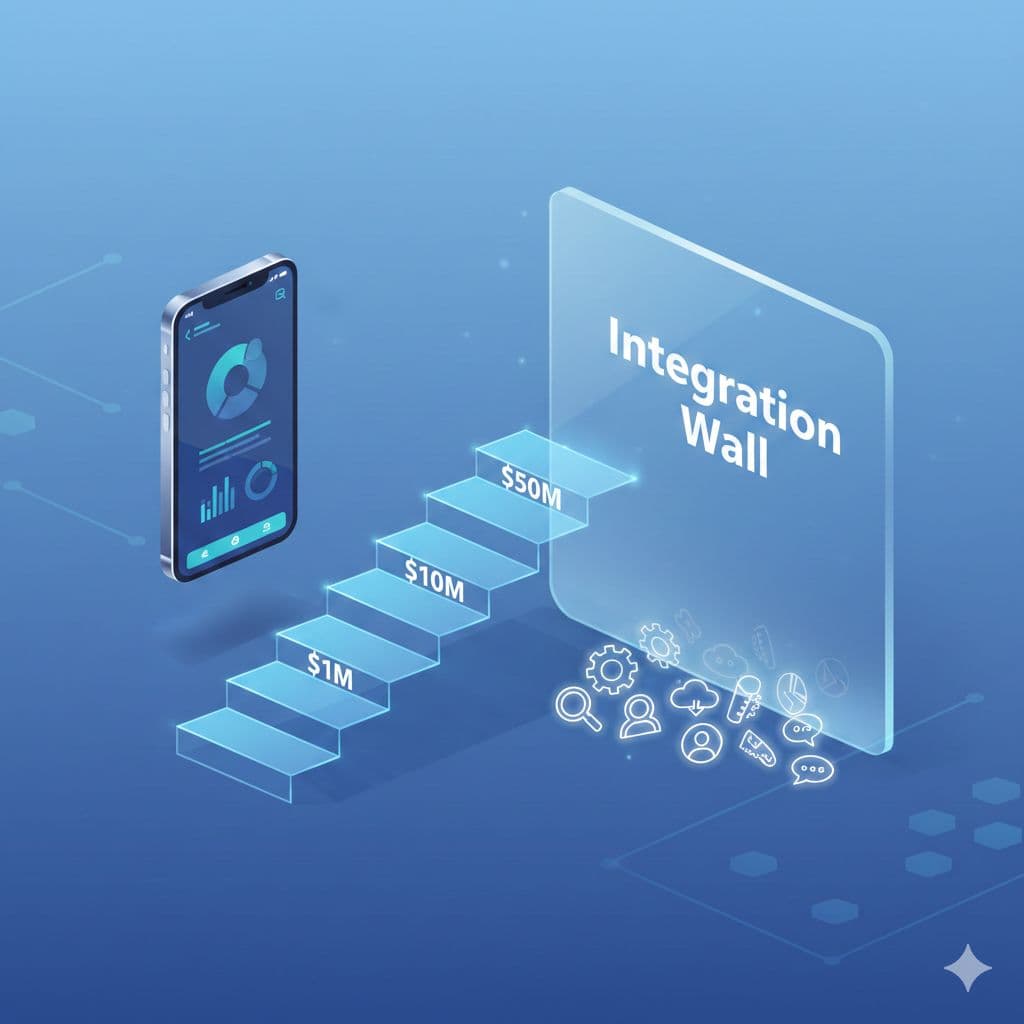
Introduction: The Million-Dollar Question Every Growing Brand FacesFor a new e-commerce brand, the common wisdom is clear: get to market fast. Launching a mobile app quickly using a popular no-code SaaS builder seems like the smartest, most efficient path forward. These platforms promise a mobile presence in weeks, offering a straightforward solution for brands eager to capture the mobile audience.But for brands that succeed and begin scaling into the $1 million to $50 million revenue range, this easy path often leads to a hidden and costly dead end. They hit a technical ceiling known as the "Integration Wall," where the generic, one-size-fits-all toolset that got them started suddenly becomes the very thing holding them back. This isn't just a technical inconvenience; it's a strategic crisis that stifles growth, frustrates customers, and leaks revenue.This article reveals the most critical, and often surprising, insights that successful CTOs have learned about unlocking the next stage of growth. It’s about moving beyond the limitations of simple builders to engineer a mobile experience that doesn't just sell products, but builds lasting enterprise value.1. The Hidden Ceiling: Why Your 'Easy' App Builder Is Built to BreakThe "Integration Wall" is the critical point where high-growth brands discover their generic SaaS app builder cannot handle the complexity of their scaling operations. This isn't a hypothetical problem; it's an inevitable technical barrier for businesses in the 1M−50M GMV range whose needs have outpaced the templated solutions they started with.These builders begin to "break" when confronted with the bespoke logic of a mature tech stack. Concrete examples include:• Implementing custom loyalty program tiers.• Integrating with unique Enterprise Resource Planning (ERP) systems.• Managing sophisticated or international subscription logic.This failure is more than a backend headache. It creates a jarring customer experience, leading to broken checkout flows or, most commonly, forcing a user out of the app and into a clunky mobile webview to complete a simple task. This friction directly fuels the "Economics of Churn," where a poor user experience leads to abandoned carts, cancelled subscriptions, and significant revenue loss. The solution isn't to find a slightly better builder, but to make a strategic shift toward building a true Retention Architecture through deep-stack integration.2. Beyond Conversion Rates: The Shocking Reality of App EngagementIt’s a well-known fact in e-commerce that native mobile apps convert at a rate three times higher than the mobile web—often exceeding 6% compared to the web’s 2.1% average. While that statistic alone is compelling, it barely scratches the surface of the true performance gap. The more surprising and impactful story is found in user engagement.When you look deeper, the data reveals that app users are not just more likely to buy; they are profoundly more connected to the brand. Compared to mobile web visitors, app users view 4.2 times more products per session and are an astonishing 18.5 times more engaged on a monthly basis, spending over 201 minutes in-app versus just 10.9 minutes on the web. This sustained engagement translates directly into long-term value, with app users generating 3 to 5 times higher Lifetime Value (LTV).The key performance indicators tell a clear story:• Conversion Rate: 3x higher than mobile web• Products Viewed Per Session: 4.2x higher• Monthly Engagement: 18.5x higher (201.8 min vs. 10.9 min)• Lifetime Value (LTV): 3-5x higherThis data reframes the entire conversation. A native app isn't just another sales channel to manage; it is a brand's primary engine for customer retention and long-term value creation.3. Stop Renting, Start Owning: Turning Your App into a Balance Sheet AssetFor scaling brands, the move from a SaaS app builder to a custom solution is a deliberate strategy called "SaaS Graduation." This represents a critical financial shift: moving from a recurring operational expense (renting a platform) to a capital investment (building a proprietary asset).The core downside of renting a SaaS builder is that you gain convenience but build zero equity. Your app runs on borrowed technology, locking you into the same feature set as your direct competitors and preventing you from creating a unique "technological moat" that defends your market position.The impact on valuation is dramatic. Market analysis shows that while brands relying on standard third-party tools see Enterprise Value to Revenue multiples in the 2.0x to 3.0x range, companies with proprietary technology command significantly higher multiples of 4.0x to 6.0x.• Valuation with Standard Tools: 2.0x – 3.0x Revenue• Valuation with Proprietary Tech: 4.0x – 6.0x RevenueOwning your app's Intellectual Property (IP) is not a vanity project. It is a direct investment in your company's terminal value. It creates a sustainable competitive advantage that can be measured on the balance sheet and leveraged during fundraising or an acquisition.4. The Subscription Trap: How a Single Bad Click Is Quietly Killing Your RevenueFor subscription-based brands, the mobile app should be the ultimate tool for managing recurring orders. Yet, this is where most SaaS builders fail spectacularly. The common user experience is deeply flawed: a customer clicks "Manage Subscription" inside the app only to be jarringly redirected to a slow-loading, non-native webview. This transition breaks the native app's Habit Loop, a critical factor in user retention, and often requires a separate, forgotten password to log in.This single point of friction is a core driver of the "Economics of Churn." When managing a subscription is difficult, customers are far more likely to cancel it altogether. This is a quiet but consistent drain on recurring revenue.The deep-stack solution eliminates this friction entirely by building a fully native subscription portal using a headless API, such as the one offered by Recharge. The difference in user experience—and its impact on LTV—is stark.Subscription Management FeatureSaaS Builder (Webview)Deep-Stack (Native UI)LTV ImpactLogin / AuthManual / Session-basedBiometric (FaceID/TouchID)Friction ReductionSkipping OrdersMultistep / LatencySingle-Tap LogicChurn PreventionOne-Time Add-onsDifficult / Separate OrderBundled in Next ChargeAOV MaximizationLoading Speed3s - 8s (Browser)<100ms (Local Cache)UX SatisfactionWith a native portal, customers can skip a delivery with a single tap, add one-time products to their next shipment to increase AOV, and log in instantly with biometrics. Eliminating these tiny points of technical friction is a critical and often overlooked component of LTV engineering.5. From Spam to Superpower: Unlocking Massive Retention with Smarter NotificationsPush notifications have a bad reputation. For many users, they are synonymous with annoying, irrelevant spam. However, the counter-intuitive reality for e-commerce brands is that a strategic push notification campaign is one of the most powerful retention drivers available.When executed properly, the results are transformative. The data shows:• Sending a single push notification within the first week after an app install can boost customer retention by 71% over the next two months.• A sophisticated, behavior-driven push strategy can increase overall retention rates by 3 to 10 times.The key is to adopt a "push-first" strategy built on deep integration. This approach prevents "channel collision"—the frustrating experience of a customer receiving a push, an SMS, and an email for the same abandoned cart. Using technology like Klaviyo's "Smart Sending" logic, brands can orchestrate messages across all channels. The system prioritizes the most effective, lowest-cost channel (push) first and can automatically suppress redundant messages in other channels if the user engages, ensuring a unified experience that feels like a helpful, personalized service.Conclusion: Is Your App a Growth Engine or an Expensive Accessory?For an e-commerce brand on the path to scale, the conclusion is clear: graduating from a simple SaaS builder to a deep-stack, custom-integrated app is not a technical preference but a strategic and financial imperative. The "easy" path of renting a templated solution eventually becomes the hardest path, limiting growth, frustrating customers, and devaluing the business.By taking control of your mobile technology, you gain the ability to own valuable IP, engineer a frictionless customer journey, and transform your app from a simple sales channel into a powerful "Retention Engine." This is the definitive move from a startup surviving on convenience to a market leader competing on experience.The logical next steps for any brand leader convinced by this argument are clear: conduct a comprehensive Technical Migration Audit to identify the breaking points in your current stack, and utilize a Mobile App ROI Calculator to model the revenue potential unlocked by a deep-stack transition.Looking at your tech stack today, is your mobile app truly built to lead your growth, or is it destined to hold you back?

Is Your Favorite Online Store Secretly Capping Its Own Growth? 5 Truths About the Speed of Modern Shopping
We’ve all been there. You pull out your phone to buy something you’ve been eyeing—a new pair of sneakers, a gift for a friend, that gadget you saw on social media. You tap the link, and you wait. And wait. The logo appears, but the images don’t. You try to scroll, but the page stutters and jumps. Within seconds, frustration wins. You close the tab and move on with your day, the purchase completely forgotten.This experience is so universal that we often dismiss it as a minor annoyance. But it's not. For online brands, that slowness is a critical, multi-million-dollar business problem with surprising and fascinating causes. The lag you feel isn't just a glitch; it's a symptom of an architectural limit—a "technical ceiling" that prevents even the most successful stores from reaching their full potential.This article unpacks five of the most impactful truths about the "Architecture of Speed" that governs success in modern e-commerce, revealing why the fastest brands aren't just better—they're built differently from the ground up.1. A single second of delay can slash conversions by 20%.The relationship between how fast a page loads and how much money a store makes is direct and punishing. Market data shows that for every one-second delay in page load time, conversion rates are reduced by an average of 20%. The modern consumer’s patience is measured in milliseconds, not minutes.The threshold for abandonment is shockingly low. According to research, 53% of mobile users will leave a site if it takes longer than three seconds to load. For a high-growth store, this turns their mobile website into a slow-moving elevator. Customers are inside and ready to buy, but they get frustrated and leave before ever reaching the checkout floor.2. The paradox of growth: The very apps that make a store successful can also cause it to fail.As an online store grows, it adds features to improve the customer experience: loyalty programs, product review widgets, advanced analytics, and marketing pixels. This is the paradox of growth. Each new feature adds weight, contributing to a "Technical Ceiling"—the point where the store's infrastructure becomes so bloated that it degrades the user experience and harms profitability.A primary cause is "App Script Bloat." Installing 10 to 20 third-party apps, a common practice for scaling brands, injects mountains of code that can bring a site to a grinding halt. This isn't just about a slow progress bar; this App Script Bloat literally blocks the website's main thread, delaying the moment a user can actually tap, scroll, or interact with the page—a critical metric known as "Interaction to Next Paint." But it's not just the sheer volume of code that causes slowdowns. The way that code requests data from the server is an equally critical, and often invisible, bottleneck.3. Many websites force your phone to download useless data, wasting time and bandwidth.When you load a product page on your phone, you often download far more information than you actually see. This inefficiency, known as "over-fetching," happens when a website’s backend sends a full package of data (including historical metadata and admin-only fields) even when the mobile screen only needs a few specific items like the product title and price.Modern architectures solve this using technologies like GraphQL, which acts like a precise order form for data. Instead of receiving a standardized, bulky package, the app can request only the exact data fields it needs to display. This targeted approach has a massive impact on performance, reducing total data transfer by up to 67% and making the shopping experience noticeably faster.4. The fastest mobile shopping experiences feel instant because they barely use the network.Have you ever noticed that a native mobile app—one you download from an app store—feels dramatically faster than that same store's mobile website? The secret isn't a faster internet connection; it's that the app leverages the power of your phone itself. A mobile website has to download its interface and product data from a server every single time you visit. A native app, however, stores its core user interface components and even product catalogs locally on your device.This "local-first persistence" is what eliminates the dreaded loading spinner. When you browse categories or tap on a product, the app is often retrieving that information directly from your phone's internal memory, not a distant server. This creates a frictionless "Discovery Engine" where browsing is instant. The result is transformative: when the friction of waiting is removed, users explore 4.2x more products than they would on a mobile site, directly leading to higher order values.5. Modern e-commerce isn't about design; it's about "Revenue Retention Architecture."The most forward-thinking brands have stopped viewing their technology as just an IT cost. Instead, they embrace a new paradigm that reframes technology from a cost center to a profit driver. In a Revenue Retention Architecture, every technical decision—from the choice of an API to the structure of the mobile frontend—is evaluated through the lens of profitability and customer lifetime value (LTV).The tangible business outcomes of this architectural shift are staggering. By prioritizing speed and performance, brands see clear, measurable results:• A 3x lift in conversion rates, with performance jumping from an average of 2% on mobile web to 6% or higher in a native app.• A 3x to 5x higher customer lifetime value (LTV) for app users compared to mobile web users.• A 2x higher repeat purchase rate.These metrics prove that the underlying technology of an e-commerce store is no longer just a support function. It is a core driver of business strategy, growth, and long-term customer loyalty.Is Your Favorite Brand Driving with the Brakes On?In 2025, speed is not a feature—it is the fundamental architecture of success. The lag and frustration that cause customers to abandon their carts are not random occurrences but the predictable outcomes of an outdated technical foundation. The brands that lead the next generation of commerce will be the ones that build for performance from the inside out.It leaves a powerful question for every entrepreneur, marketer, and shopper. How many brands are hitting a "Technical Ceiling" they don't even know exists, and how much potential revenue is being lost in every single second of load time? For the brands that win the next decade, the architecture of speed won't just be a competitive advantage; it will be the entire foundation of their business.

Your Mobile Website Is a Leaky Bucket. Here's Why Native Apps Are the Only Fix.
Introduction: The Frustration of Lost Mobile SalesFor the frustrated scaler, there is a structural contradiction at the heart of your business that threatens long-term viability. Your analytics show a flood of mobile traffic—as much as 78% of all visitors—yet your revenue fails to reflect that dominance. This disconnect, the "Mobile Conversion Gap," is not a traffic problem; it's a conversion problem. It’s a critical revenue leak that puts a ceiling on your growth, no matter how much you spend on ads.Many brands are told a Progressive Web App (PWA) is the silver bullet. It promises the best of both worlds—the reach of the web with the feel of an app. However, a deeper look reveals that PWAs are often a halfway measure that fails to address the fundamental issues costing you sales. The real solution lies in understanding why your mobile website is failing and how a native app can transform your highest-intent customers into a powerful, sustainable revenue engine.This article will break down the surprising truths about the mobile shopping experience. We'll explore why native apps are no longer a luxury but a mandatory tool for any e-commerce brand serious about scaling its revenue and building brand sovereignty.Takeaway 1: Your Mobile Website Isn't Built for Revenue, It's Built for ReachThe core problem lies in a strategic misunderstanding: the mobile web is designed for discovery, not for loyalty. Think of your mobile website or PWA as a "Billboard"—it's excellent for catching the eye of casual browsers through SEO and social media. It serves a vital role at the top of the funnel, generating initial awareness and reach.A native app, however, operates as a "Private Lounge." It's an exclusive environment built specifically for your best customers—the ones who have already made a psychological commitment by downloading your app. The weakness of the "Billboard" is that it exists in the chaotic environment of a web browser, competing with endless tabs, notifications, and distractions. In contrast, the native app offers a focused "walled garden" where your brand owns 100% of the customer's attention, free from outside competition.This distinction is not just a metaphor; it's a strategic imperative for any brand looking to increase customer lifetime value (LTV).For the scaling brand, this "walled garden" is the only way to build a sustainable, high-LTV business.Takeaway 2: The Staggering Truth About Mobile Cart AbandonmentIf you want to understand the true cost of the Mobile Conversion Gap, look no further than your checkout. According to industry data, mobile web and PWA users abandon their shopping carts at an astonishing rate of 83% to 97%. This means for every 100 customers who add a product to their cart, up to 97 will leave without paying.Now, compare that to the native app experience. The cart abandonment rate for native mobile apps is only 20%. The financial implications are staggering. Not only are you losing far fewer carts in an app, but the carts you are winning are inherently more valuable, with an Average Order Value (AOV) of $155+ for native apps versus as low as $86 for mobile web.Why is this gap so massive? The primary reason is a concept called "Input Friction." The simple hassle of typing out shipping addresses, billing information, and credit card numbers on a small touchscreen is a major deterrent. Native apps are engineered to eliminate this friction almost entirely, a point we'll detail next.Takeaway 3: Native Apps Win on the "Physics of Velocity"The superior performance of native apps isn't just about aesthetics; it's about architecture. This superior performance is rooted in what can be called the "Physics of Velocity"—the fundamental advantage native apps have by running directly on the device's hardware, rather than inside the limitations of a web browser.First, native apps are built for speed. They use local databases (like SQLite) to store key data like your product catalog and user information directly on the phone. This allows the UI "scaffolding" to render instantly, creating a near-instant loading experience. A PWA, despite its caching abilities, is still fundamentally limited by the browser's processing layer and network latency. This speed difference has a direct and dramatic impact on your bottom line: a mere 1-second delay in mobile load time can reduce conversion rates by as much as 20%.Second, native apps deliver a truly frictionless checkout. They have deep, seamless integration with the phone's operating system, allowing for one-tap payments with Apple Pay and Google Pay and instant logins with biometrics like FaceID and TouchID. This eliminates the "Input Friction" that plagues mobile websites. The result is a smooth, secure, and lightning-fast purchase process that transforms user engagement. In fact, this superior experience is why native app users view 4.2 times more products per session than mobile web users—when browsing is effortless, customers explore more.Takeaway 4: Apple Intentionally Limits PWAs on the iPhoneFor any e-commerce brand, retention is the only antidote to skyrocketing Customer Acquisition Cost (CAC). The "killer feature" for retention is the push notification—a direct, immediate, and free communication channel to your customer's home screen. By mastering this channel, you can turn a variable expense (ad spend) into a fixed investment in an owned asset. While both PWAs and native apps offer push notifications, there's a critical difference that puts PWAs at a major disadvantage, especially on iOS.Apple, the gatekeeper of the world's most valuable e-commerce customers, intentionally limits the functionality of PWA push notifications on the iPhone. Before a user can even receive a notification from a PWA, they must first perform a high-friction, multi-step process to manually "Add to Home Screen." Most casual users simply will not do this. This is not a technical oversight; it is a strategic decision by Apple to maintain the primacy of its App Store ecosystem and the superior, controlled experience that native apps provide.This deliberate limitation means your most valuable customers—high-AOV iPhone users—receive a "second-class" experience with a PWA. They are cut off from the instant, rich, and engaging notifications that a native app can deliver. This fundamental difference underscores a vital strategic conclusion.PWAs are for reach, but native apps are for revenue.Conclusion: Are You Building a Billboard or a VIP Lounge?The path to scaling e-commerce revenue isn't about driving more traffic to a leaky mobile website. It's about converting your best customers into a loyal, high-LTV audience that resides within your own branded ecosystem. A native app provides the controlled, friction-free environment necessary to achieve this.This strategy represents a fundamental shift. Instead of continuously paying "gatekeepers" like Meta and Google to retarget users who abandoned their carts, you must invest in an asset—a native app—that allows you to own the customer relationship directly. This is not a philosophical choice; it is a crucial investment decision. You must calculate the cost of inaction—the revenue being lost daily by forcing your best customers through a broken mobile web experience. For a scaling brand, the development of a native ecosystem is no longer a luxury—it is a mandatory engine for survival.Is your mobile strategy designed to attract temporary visitors, or to build a permanent home for your best customers?